
Digital Marketing for Business Growth: 10 Proven Strategies
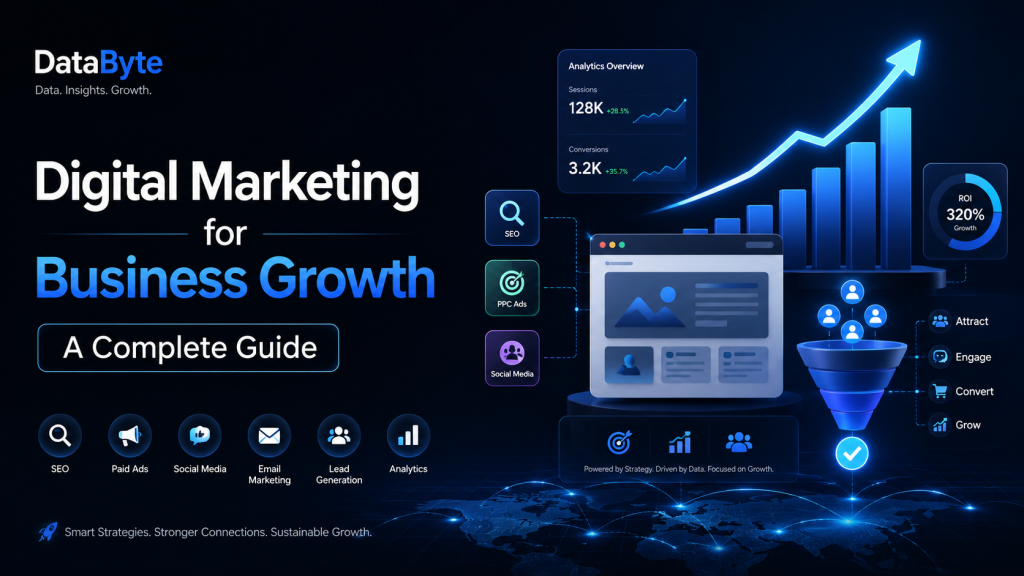
If you run a small business, a startup, or a local service in India, you have probably asked yourself one question more than once: how do bigger brands keep getting customers while yours struggles to be seen? The answer, most of the time, is digital marketing for business growth. It is no longer a “nice to have” — it is how modern businesses attract customers, build trust, and grow revenue in a market where almost everyone searches, scrolls, and shops online first.
In this guide, we will break down what digital marketing actually means, why it matters for businesses of every size, and exactly how you can use it — step by step — to grow your business without wasting money on guesswork. Whether you run a boutique in Surat, a clinic in Pune, or a D2C brand shipping pan-India, the same principles apply.
Table of Contents
- What Is Digital Marketing?
- Why Digital Marketing Is Important for Business Growth
- How to Grow Your Business With Digital Marketing
- Digital Marketing vs Traditional Marketing
- Best Digital Marketing Strategy for Small Businesses
- Common Digital Marketing Mistakes to Avoid
- How DataByte Helps Businesses Grow
- Conclusion
- FAQs
What Is Digital Marketing?
In simple words, digital marketing means promoting your business using the internet instead of (or alongside) newspapers, hoardings, and pamphlets. It covers every channel where your future customer might be spending time online.
The main channels that make up a solid digital marketing strategy include:
- SEO (Search Engine Optimisation): Helping your website show up when people search on Google.
- Social media marketing: Building an audience on Instagram, Facebook, and LinkedIn.
- Google Ads: Paid search ads that appear when someone is actively looking for your product or service.
- Meta Ads: Paid ads on Facebook and Instagram to build awareness and generate leads.
- Email marketing: Staying in touch with customers and leads through targeted emails.
- Content marketing: Blogs, videos, and guides that answer your customer’s questions.
- Website development: A fast, mobile-friendly website that converts visitors into customers.
- Local SEO: Getting found by customers searching “near me” in your city or locality.
- AI automation: Using AI tools to follow up with leads, answer queries, and save time.
Used together, these channels form a complete digital marketing strategy that works round the clock — unlike a newspaper ad that is forgotten the next day.
Why Digital Marketing Is Important for Business Growth
Here is why so many Indian businesses are shifting their budgets from traditional advertising to digital marketing for business growth:
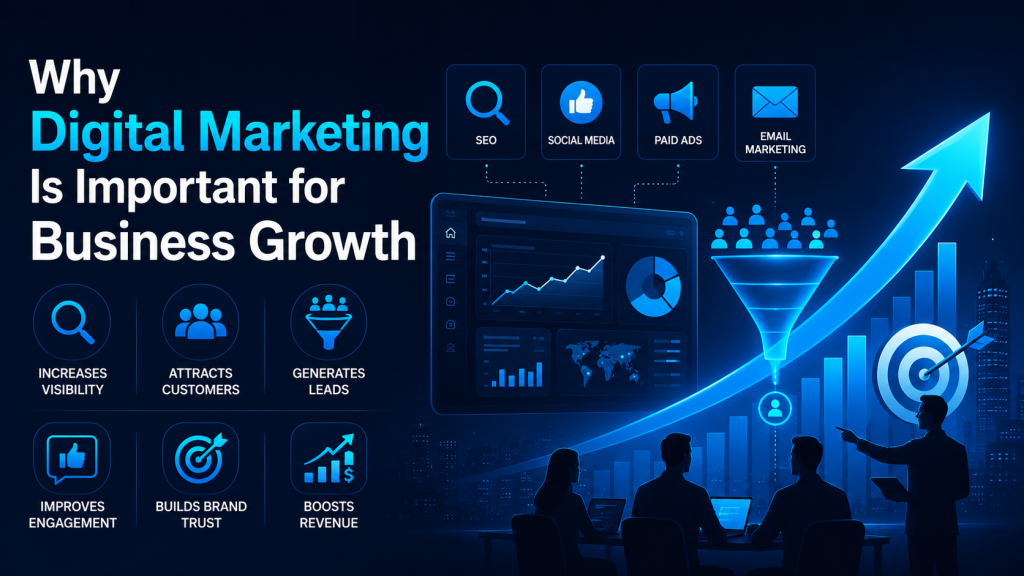
- Reaching the right audience: You can target people by age, location, interest, and even purchase intent, instead of broadcasting to everyone.
- Increasing brand visibility: Consistent SEO and social media presence keeps your business in front of potential customers.
- Generating qualified leads: Ads and landing pages bring in people who are already interested, not random footfall.
- Tracking marketing performance: Every click, call, and enquiry can be measured — something print and radio ads can’t offer.
- Controlling marketing budgets: You can start with as little as ₹5,000–₹10,000 a month and scale up only when it works.
- Improving customer engagement: Social media and email let you talk directly with your audience, not just at them.
- Competing with larger brands: A well-optimised local business can outrank a national brand for local searches.
- Increasing sales and revenue: At the end of the day, all of the above leads to one thing — more paying customers.
According to Think with Google, consumer research and purchase decisions increasingly begin with an online search, which is exactly why SEO for business growth and paid ads matter so much today.
How to Grow Your Business With Digital Marketing
Knowing the channels is one thing. Knowing how to use them well is what actually moves the needle. Here is a practical breakdown — this is how to grow business with digital marketing, one strategy at a time.
1. Build a Professional and Mobile-Friendly Website
Your website is your digital storefront. If it loads slowly or looks broken on a phone, visitors leave within seconds.
Example: A furniture store in Vadodara redesigned its site to load in under 3 seconds on mobile and saw enquiry form submissions double within two months.
Tip: Always test your website on a mobile phone before you consider it “done” — most Indian traffic is mobile-first. Explore professional website development services if your current site needs an upgrade.
2. Improve Google Rankings With SEO
SEO helps your website appear when people search for what you sell, without paying for every click.
Example: A CA firm in Ahmedabad started ranking for “tax consultant near me” after six months of consistent SEO, bringing in organic enquiries every week.
Tip: Focus on one clear keyword per page instead of trying to rank for everything at once. Our SEO services are built around this exact approach.
3. Use Local SEO to Attract Nearby Customers
Local SEO makes sure your business shows up on Google Maps and “near me” searches — critical for shops, clinics, restaurants, and salons.
Example: A salon in Umargam optimised its Google Business Profile with photos and reviews and started getting 5–6 walk-ins a week directly from Maps.
Tip: Ask happy customers to leave a Google review — it is free and directly improves local rankings.
4. Run Google Ads for High-Intent Leads
Google Ads put your business in front of people who are actively searching and ready to buy or enquire.
Example: A real estate broker spent ₹15,000 a month on Google Ads and generated 40+ site-visit enquiries in the first month alone.
Tip: Always send ad traffic to a dedicated landing page, not your homepage, for better conversions. Learn more about Google Ads management from our team.
5. Use Meta Ads for Awareness and Lead Generation
Meta Ads (Facebook and Instagram) are great for building brand awareness and collecting leads through simple forms.
Example: A clothing brand used Meta Ads with a ₹500/day budget and grew its Instagram following by 3,000 in a month, driving direct DM orders.
Tip: Use short video ads — they consistently outperform static images on Meta platforms.
6. Build Trust Through Social Media
Regular, authentic posting builds familiarity, and familiarity builds trust — which eventually leads to sales.
Example: A home bakery in Vapi posted behind-the-scenes reels weekly and converted followers into repeat customers for festive orders.
Tip: Show your process, your team, and your customers — people trust real content over polished stock photos.
7. Create Useful and SEO-Friendly Content
Blogs, guides, and videos that genuinely answer customer questions build long-term organic traffic.
Example: A skincare brand’s blog on “best skincare routine for humid weather” continues to bring organic visitors months after publishing.
Tip: Write for your customer’s actual questions, not just for keywords — the keyword ranking follows naturally.
8. Use Email Marketing for Customer Retention
It costs far less to sell to an existing customer than to find a new one, and email keeps that relationship alive.
Example: An online grocery store sends a weekly offers email and sees a consistent spike in orders every time it goes out.
Tip: Segment your list — send different emails to first-time buyers versus repeat customers.
9. Track Results Using Google Analytics
You cannot improve what you do not measure. Analytics shows exactly where your customers come from and what they do on your site.
Example: A furniture brand discovered through Google Analytics that most conversions came from mobile Instagram traffic, so it shifted more budget there.
Tip: Set up goal tracking for form submissions and calls, not just page views.
10. Use AI Automation to Save Time and Improve Follow-Ups
AI automation for business handles repetitive tasks — replying to common questions, following up with leads, and qualifying enquiries — so your team can focus on closing sales.
Example: A clinic used an AI chatbot to answer appointment queries after hours, reducing missed leads by a large margin.
Tip: Start small — automate just your lead follow-up messages before automating everything else. See how our AI automation solutions work.
Digital Marketing vs Traditional Marketing
Many business owners still ask whether traditional advertising still has a place. Here is an honest comparison:
| Factor | Digital Marketing | Traditional Marketing |
|---|---|---|
| Cost | Flexible, starts small (₹5,000+/month) | High upfront cost (print, hoardings, TV) |
| Targeting | Precise — by age, location, interest, intent | Broad, mostly untargeted |
| Reach | Local to global, on demand | Usually limited to one region |
| Tracking | Real-time data on clicks, calls, sales | Very difficult to measure accurately |
| Speed | Campaigns can launch in hours | Weeks of planning and printing |
| Personalisation | Highly personalised messaging | Same message for everyone |
| Return on Investment | Measurable and optimisable over time | Hard to calculate ROI |
| Lead Generation | Direct forms, calls, WhatsApp enquiries | Indirect, relies on walk-ins/calls |
This does not mean traditional marketing is useless — for certain hyperlocal businesses, a mix of both works well. But for most businesses today, digital marketing strategies offer far better control and measurable results.
Best Digital Marketing Strategy for Small Businesses
If you are just getting started, don’t try to do everything at once. Here is a simple, proven order to follow:
- Define your target audience — know exactly who you’re trying to reach before spending a rupee.
- Create a professional website — this is your base for every other channel.
- Optimise your Google Business Profile — essential for local visibility.
- Start SEO — begin building organic, long-term traffic.
- Post consistently on social media — build familiarity and trust.
- Run small-budget ads — test what works with a modest spend first.
- Track enquiries and conversions — know exactly what’s driving results.
- Improve campaigns based on data — double down on what works, cut what doesn’t.
This is genuinely one of the most practical online marketing for small businesses approaches — start with a limited monthly budget, measure results carefully, and scale spending only on what’s proven to work.
Common Digital Marketing Mistakes to Avoid
Even a good strategy can fail if these common mistakes creep in:
- Running ads without a proper landing page
- Targeting the wrong audience
- Ignoring mobile users
- Not tracking conversions
- Posting on social media without a strategy
- Buying fake followers or engagement
- Ignoring SEO in favour of only paid ads
- Using copied or low-quality content
- Not following up with leads quickly
- Expecting instant results from long-term channels like SEO
Avoiding these mistakes alone can significantly improve the return on your digital marketing for business growth efforts.
How DataByte Helps Businesses Grow
At DataByte, we work as a Digital Marketing and AI Agency for small businesses, startups, and local brands across India. Rather than offering one-size-fits-all packages, we build strategies around your specific goals, audience, location, competition, and budget.
Our core services include:
- Professional website design and development
- SEO services for long-term organic growth
- Local SEO for map and “near me” visibility
- Google Ads management for high-intent leads
- Meta Ads services for awareness and lead generation
- Social media marketing services
- Lead generation systems built around your sales process
- Content creation — blogs, reels, and creatives
- Marketing automation and email workflows
- Analytics and reporting so you always know what’s working
- AI automation solutions for faster follow-ups and support
We don’t believe in guaranteed ranking claims or overnight results — genuine growth through digital marketing for business growth takes consistent, data-backed effort. What we do promise is a customised strategy, transparent reporting, and a team that treats your business goals as our own.
Want to see how this could work for your business? Contact DataByte for a free consultation, or learn more about DataByte on our About page.
Conclusion
Growing a business today is no longer just about a good product or service — it’s about being visible where your customers are already looking. From SEO and social media to Google Ads and AI automation, digital marketing for business growth gives small businesses, startups, and local brands the tools to compete, generate leads, and increase revenue, all while keeping a close eye on budget and results.
Start simple: get your website right, optimise for local search, and test small ad budgets before scaling. Track everything, fix what isn’t working, and be patient with channels like SEO that build momentum over time.
If you’d rather have experts handle the strategy while you focus on running your business, contact DataByte today for a personalised digital marketing plan built around your goals.
Frequently Asked Questions
1. How does digital marketing help a business grow?
Digital marketing helps a business grow by increasing online visibility, reaching the right audience through targeted ads and SEO, generating qualified leads, and allowing owners to track exactly what’s working — leading to more enquiries and sales over time.
2. Which digital marketing strategy is best for small businesses?
A mix of a professional website, local SEO, consistent social media posting, and small-budget Google or Meta Ads works best for small businesses. Start small, measure results, and scale the channels that perform well.
3. How much should a small business spend on digital marketing?
There’s no fixed number, but many small businesses in India start with ₹10,000–₹30,000 per month across SEO, social media, and ads, then increase the budget gradually as they see measurable returns.
4. How long does SEO take to show results?
SEO typically takes 3 to 6 months to show noticeable ranking improvements, and longer for competitive keywords. It’s a long-term investment that keeps paying off, unlike paid ads that stop the moment you stop paying.
5. Are Google Ads suitable for small businesses?
Yes. Google Ads work well for small businesses because you can set a daily budget, target specific locations and keywords, and only pay when someone clicks — making it easy to control spending and measure ROI.
6. Why should a business hire a digital marketing agency?
An agency brings experience across SEO, ads, content, and analytics, saving business owners time and reducing costly trial-and-error. A good agency also builds a strategy tailored to your goals instead of a generic template.
7. How can AI automation help a business?
AI automation can respond to customer queries instantly, follow up with leads automatically, and handle repetitive tasks like appointment reminders — helping businesses save time and avoid losing potential customers to slow response times.