
A business owner posts on Instagram three times a week, runs a few Google Ads, and has a website that “looks fine.” Six months later, the sales numbers haven’t moved much. That’s not a rare story. It’s the default experience for most small businesses in India right now, and it rarely comes down to laziness. It comes down to missing pieces: no real strategy connecting the pieces, no tracking that tells you what’s working, and no one testing and adjusting along the way.
This guide walks through digital marketing problems and solutions that come up again and again for small businesses, startups, local shops, and growing brands. Each problem gets a plain explanation of why it happens and what actually fixes it, based on patterns we see working with clients at DataByte, a digital marketing agency in Nashik.

Table of Contents
- What Are Digital Marketing Problems?
- Why Businesses Struggle With Digital Marketing
- 15 Common Digital Marketing Problems and Solutions
- Digital Marketing Problem and Solution Checklist
- How to Identify Which Digital Marketing Problem Your Business Has
- How DataByte Solves Digital Marketing Problems
- Conclusion
- Frequently Asked Questions
What Are Digital Marketing Problems?
Digital marketing problems are the specific, recurring reasons a business’s online efforts don’t turn into leads or sales. Sometimes it’s a strategy problem: nobody has decided who the business is actually trying to reach. Sometimes it’s tracking, where the business has no idea which ₹ spent on ads or content actually brought in a customer. Other times it’s simpler than that: the website loads slowly, the content is inconsistent, or the leads coming in are the wrong fit entirely.
None of these problems are unusual, and none of them mean a business is “bad at marketing.” Most businesses figure out digital marketing the same way: by hitting a wall, then working backward to find out what broke.
Why Businesses Struggle With Digital Marketing
A few patterns show up in nearly every audit we run:
- No clear marketing goals. “Get more customers” isn’t a goal you can build a campaign around. Without a specific number and timeline, there’s nothing to measure against.
- Trying every platform at once. Instagram, Google Ads, LinkedIn, YouTube, email, all at 20% effort instead of two channels at full effort.
- Skipping audience research. Guessing who the customer is, instead of finding out.
- Weak offers. Even great targeting can’t fix an offer nobody wants.
- Poor tracking. Spending money without knowing which part of it worked.
- Limited skills or time. One person trying to be an SEO expert, ad strategist, designer, and copywriter at once.
- Inconsistent execution. Three weeks of daily posting, then silence for a month.
- Chasing vanity metrics. Likes and impressions feel good, but they don’t pay the bills. Leads and revenue do.
15 Common Digital Marketing Problems and Solutions
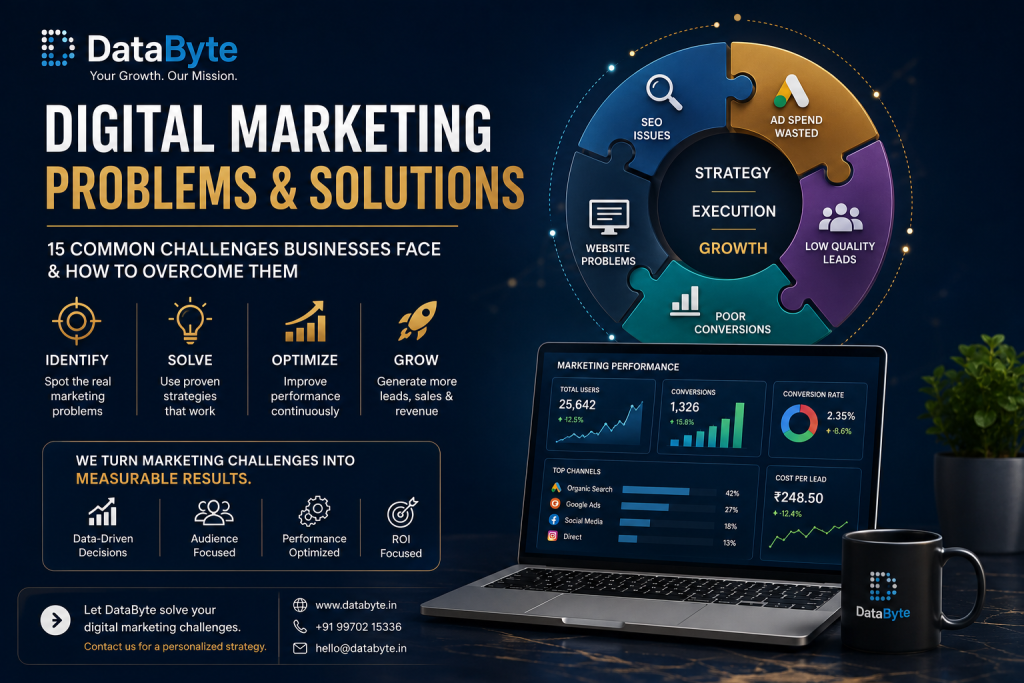
1. Not Having a Clear Digital Marketing Strategy
The problem: Content goes out whenever someone remembers to post it. Ads run without a plan behind them. Every month looks different because there’s no underlying direction.
Why it happens: Marketing gets treated as a task list rather than a business function. Nobody has sat down to map goals to channels to a timeline.
The solution:
- Define what the business actually wants (leads, footfall, online sales — pick one primary goal)
- Choose 2-3 measurable KPIs that tie directly to that goal
- Map the customer journey from “never heard of us” to “paying customer”
- Pick channels based on where the audience already is, not what’s trending
- Build a 90-day marketing plan with monthly checkpoints
How DataByte can help: This is where a proper digital marketing strategy session earns its cost — before a single ad runs or a single post goes out.
2. Targeting the Wrong Audience
The problem: Traffic looks fine on paper, but almost none of it converts. Leads come in, but half aren’t even in the target city or budget range.
Why it happens: Audience settings are left broad “to reach more people,” and nobody has actually written down who the ideal customer is.
The solution:
- Build 2-3 detailed customer personas based on real customers, not guesses
- Research the specific problems those customers are trying to solve
- Study search intent behind the keywords they use
- Test narrower audience segments before scaling budget
- Actively exclude audiences that clearly won’t convert (wrong location, wrong age group, competitors)
3. Low Website Traffic
The problem: The website exists, but almost nobody finds it through Google. Most traffic, if any, comes from people who already knew the business name.
Why it happens: Weak keyword targeting, thin content, and unresolved technical issues keep the site out of relevant search results.
The solution:
- Do proper keyword research around what customers actually search
- Fix on-page SEO — titles, headings, meta descriptions
- Publish genuinely useful content, not filler
- Resolve technical SEO issues (speed, mobile, broken links)
- Build relevant backlinks over time
- Strengthen local SEO signals if the business serves a specific area
How DataByte can help: Our SEO services start with exactly this kind of audit — finding out why the site isn’t showing up before writing a single new page.
4. Website Visitors Are Not Converting
The problem: Traffic is decent, but visitors leave without calling, filling a form, or buying anything.
Why it happens: Confusing layouts, buried contact information, no trust signals, and pages that take too long to load on mobile.
The solution:
- Redesign landing pages around one clear goal per page
- Use a single, obvious call-to-action instead of five competing ones
- Add testimonials, reviews, and other trust signals near the decision point
- Cut form fields down to the essentials
- Fix mobile loading speed — most Indian traffic is on mobile
- Test different headlines and offers against each other
5. Poor Search Engine Rankings
The problem: Pages sit on page 3 or beyond for keywords that matter, even after months of “doing SEO.”
Why it happens: A mix of indexing issues, thin content, technical errors, and simply underestimating how competitive the keyword is.
The solution:
- Run a full SEO audit to find what’s actually broken
- Fix titles and meta descriptions across the site
- Strengthen internal linking between related pages
- Add schema markup so Google understands the content better
- Improve content depth and usefulness
- Build backlinks the honest way — through outreach and genuinely useful content, following Google’s own SEO guidance
6. Google Ads Are Spending Money Without Results
The problem: The campaign is live, the budget is being spent daily, but leads are either not showing up or are completely irrelevant.
Why it happens: Broad match keywords catching unrelated searches, no conversion tracking set up, and landing pages that don’t match what the ad promised.
The solution:
- Review the actual search terms triggering your ads
- Add negative keywords aggressively
- Tighten ad relevance to match search intent
- Set up proper conversion tracking before spending another rupee
- Test landing pages against each other
- Optimise toward leads and revenue, not just clicks
7. Meta Ads Are Generating Low-Quality Leads
The problem: The lead count looks great in the ads dashboard. Then the sales team calls, and most numbers are wrong, uninterested, or simply never respond.
Why it happens: Instant forms make it too easy to submit without real intent, targeting is too broad, and there’s no qualification step before a lead reaches sales.
The solution:
- Sharpen ad messaging so it filters out the wrong audience before they click
- Add one or two qualifying questions to the lead form
- Test tighter audience segments instead of “everyone in the city”
- Use creative that sets realistic expectations rather than over-promising
- Connect leads directly into a CRM
- Follow up within minutes, not days — speed changes conversion rates dramatically, and following Meta’s own best practices for lead ads helps keep forms from attracting the wrong people in the first place
8. Social Media Engagement Is Low
The problem: Posts go out consistently, but likes, comments, and shares stay flat month after month.
Why it happens: Content is overly promotional, doesn’t follow any real content pillars, and chases trends that have nothing to do with the business.
The solution:
- Build 3-4 clear content pillars relevant to the business
- Mix in educational and relatable content, not just offers
- Open with a hook in the first line or first second of video
- Reply to comments and DMs instead of letting them sit
- Show the people and process behind the business
- Post on a consistent schedule rather than in bursts
9. Content Is Not Ranking or Generating Leads
The problem: Blog posts get published, but they don’t rank, don’t get read, and definitely don’t lead to enquiries.
Why it happens: Content is written to fill a calendar rather than to answer a real question, or it’s too close to something already published elsewhere.
The solution:
- Match the content to actual search intent
- Write in an original voice instead of rehashing what’s already ranking
- Use proper heading structure so both readers and Google can scan it
- Include real examples, not generic statements
- Link internally to related pages and posts
- Update and improve older posts instead of always starting fresh
- End with a clear next step for the reader
10. Leads Are Not Turning Into Customers
The problem: The marketing works. Leads come in, but very few actually become paying customers.
Why it happens: Slow follow-up, no lead qualification process, and a sales conversation that doesn’t match what the marketing promised.
The solution:
- Contact new leads as fast as possible, ideally within minutes
- Use basic lead scoring to prioritise who to call first
- Build a simple follow-up sequence for leads who don’t answer immediately
- Automate reminders through email or WhatsApp
- Train whoever handles sales calls on how to have that first conversation
- Track every lead’s status in a CRM so nothing falls through
11. Businesses Cannot Measure Marketing ROI
The problem: Money goes into ads, content, and tools every month, but nobody can say with confidence what came back from it.
Why it happens: No proper tracking setup, unclear attribution between channels, and a habit of looking only at clicks or impressions.
The solution:
- Set up Google Analytics 4 properly on the site
- Use Google Tag Manager to track key actions without constant developer help
- Track calls and form submissions, not just page views
- Connect ad platforms so spend and results sit side by side
- Watch cost per lead, CAC, ROAS, and actual revenue — not just traffic
- Build one simple dashboard instead of five scattered reports
How DataByte can help: Our analytics and reporting work is built around this exact gap — connecting spend to outcomes so decisions stop being guesses.
12. Marketing Budget Is Too Limited
The problem: A small budget gets split across five platforms, and none of them get enough spend to actually produce results.
Why it happens: The instinct to “be everywhere” with a limited budget, instead of going deep on one or two channels first.
The solution:
- Pick one or two high-impact channels and commit to them
- Start with small, deliberate tests before scaling anything
- Focus paid spend on high-intent keywords first
- Reuse and repurpose content across formats instead of creating from scratch every time
- Build organic visibility (SEO, social, Google Business Profile) to reduce long-term ad dependence
- Only scale campaigns that are already proven to work
13. Competitors Are Getting More Online Visibility
The problem: A competitor with a similar or smaller offering seems to show up everywhere (search results, social media, reviews) while your business stays quiet.
Why it happens: Stronger websites, more consistent content, more reviews, and simply more advertising activity.
The solution:
- Study what competitors are actually doing well (and where they’re weak)
- Find content and keyword gaps they haven’t covered
- Sharpen brand positioning around what makes the business genuinely different
- Build offers strong enough to stand out on their own merit
- Collect genuine customer reviews consistently
- Own a specific niche instead of trying to compete on everything at once
14. Digital Marketing Results Are Inconsistent
The problem: One month looks great, the next looks flat, and nobody can explain why the numbers swing so much.
Why it happens: Campaigns get stopped too early, strategy changes every few weeks, and execution isn’t consistent enough to tell what’s actually working.
The solution:
- Set realistic timelines before judging a campaign’s performance
- Follow a testing framework instead of changing everything at once
- Review results weekly for quick fixes, monthly for strategy calls
- Keep a simple record of what changed and when
- Give campaigns enough data before making a decision
- Balance short-term ad spend with long-term SEO so growth doesn’t depend on one channel
15. Trying to Manage Everything Without Expertise
The problem: One person, often the owner, is handling ads, SEO, social media, design, and website updates, all after hours, alongside actually running the business.
Why it happens: There’s no time to become an expert in five different disciplines, and each platform changes its rules constantly.
The solution:
- Identify which tasks genuinely need specialist support
- Use proper tools instead of free workarounds that eat up hours
- Build simple systems and checklists for recurring tasks
- Outsource the strategy and technical work that has the steepest learning curve
- Keep ownership of the business goals and final decisions in-house
This is usually the point where working with a performance marketing agency like DataByte makes sense — not to hand over control of the business, but to get the specialist execution that’s hard to build in-house without years of dedicated experience.
Digital Marketing Problem and Solution Checklist
| Digital Marketing Problem | Main Cause | Recommended Solution | Metric to Track |
|---|---|---|---|
| No clear strategy | No defined goals or KPIs | Build a 90-day marketing plan | Goal completion rate |
| Wrong audience | Broad, undefined targeting | Build detailed personas | Lead-to-customer ratio |
| Low website traffic | Weak SEO, thin content | Keyword research + on-page SEO | Organic sessions |
| Low conversion rate | Weak CTAs, poor trust signals | Landing page redesign | Conversion rate |
| Poor Google rankings | Technical + content issues | Full SEO audit and fixes | Keyword position |
| Google Ads underperforming | No tracking, broad keywords | Conversion tracking + negative keywords | Cost per lead |
| Low-quality Meta leads | Easy forms, broad targeting | Qualifying questions + CRM | Lead qualification rate |
| Low social engagement | Promotional-only content | Content pillars + consistency | Engagement rate |
| Content not converting | Weak search intent match | Rewrite around intent + CTA | Organic leads |
| Leads not converting to sales | Slow, unstructured follow-up | Lead scoring + fast response | Lead-to-sale rate |
| Can’t measure ROI | No analytics setup | GA4 + conversion tracking | Cost per acquisition |
| Limited budget | Spread across too many channels | Focus on 1-2 channels | ROAS |
| Losing to competitors | No differentiation | Competitor research + positioning | Share of voice |
| Inconsistent results | No testing framework | Weekly/monthly review cycle | Month-on-month growth |
| No in-house expertise | Time and skill gaps | Outsource strategy + execution | Overall marketing ROI |
How to Identify Which Digital Marketing Problem Your Business Has
Before fixing anything, it helps to run a quick internal audit:
- Review where your traffic actually comes from
- Check whether conversion tracking is even set up correctly
- Look at the quality of leads coming in, not just the count
- Measure your landing page conversion rate
- Review the actual search terms triggering your ads
- Check website speed and mobile performance
- Review current SEO rankings for your priority keywords
- Evaluate how fast your team follows up on new leads
- Compare total marketing cost against the revenue it’s actually generating
Most businesses find two or three of these areas are the real bottleneck — not everything at once.
How DataByte Solves Digital Marketing Problems
DataByte works as a digital marketing agency built around outcomes rather than activity. The services that come up most often when solving the problems above include:
- Digital marketing strategy and planning
- Performance marketing (Google Ads and Meta Ads)
- Search engine optimisation and local SEO
- Social media marketing
- Landing page design and website development
- Content marketing
- Analytics and reporting
- Lead-generation systems and marketing automation
The process behind all of it stays the same regardless of the problem:
- Research — understand the market, audience, and current gaps
- Strategy — decide the right channel mix, offer, and tracking plan
- Launch — get campaigns, pages, and content live
- Measure — track what’s actually happening, not what looks good
- Optimise — fix what’s underperforming
- Scale — put more budget behind what’s already working
None of this comes with a guaranteed ranking position, a fixed lead number, or a promised ROAS — anyone claiming that upfront isn’t being straight with you. What DataByte does commit to is a transparent process and honest reporting at every stage. If you’d like to talk through where your business currently stands, you can check our common digital marketing questions or contact DataByte for a consultation.
Conclusion
Digital marketing problems and solutions rarely come down to “post more” or “spend more.” The businesses that consistently grow are the ones with a clear strategy, accurate tracking, a real understanding of their audience, and the discipline to test and adjust instead of guessing. Most of the fifteen problems above trace back to one of those four things missing.
If any of this sounds familiar, the first step isn’t a bigger budget — it’s an honest audit of what’s actually broken. From there, fixing it becomes a lot more straightforward. For a closer look at where digital marketing fits into overall business growth, our guide on digital marketing for business growth covers the bigger picture, and our digital marketing for small businesses guide breaks down the basics for anyone just starting out.
Ready to figure out what’s actually holding your marketing back? Book a free consultation with DataByte and get a straight answer.

Frequently Asked Questions
What are the most common digital marketing problems?
The most common ones are having no clear strategy, targeting the wrong audience, poor website conversion rates, weak SEO rankings, Google or Meta ads that spend money without results, and no way to measure ROI. Most businesses face a combination of two or three of these at once, not all fifteen simultaneously.
Why do digital marketing campaigns fail?
Campaigns usually fail because of unclear goals, missing conversion tracking, mismatched landing pages, or simply not giving a campaign enough time and budget to gather meaningful data before judging it. Stopping too early is one of the most common, and most avoidable, mistakes.
How can small businesses solve digital marketing problems?
Start with a proper audit of what’s actually happening — traffic sources, lead quality, tracking accuracy, and conversion rates. From there, focus on one or two high-impact channels instead of spreading a limited budget across everything at once, and build a simple 90-day plan around clear goals.
How can I improve the quality of online leads?
Sharpen your audience targeting, add qualifying questions to lead forms, write ad copy that sets realistic expectations, and connect leads to a CRM so follow-up happens quickly. Lead quality almost always improves once tracking shows you which sources are producing the wrong-fit leads.
Why are my Google Ads not generating conversions?
Usually it’s a combination of broad match keywords pulling in irrelevant searches, missing or broken conversion tracking, and a landing page that doesn’t match the ad’s promise. Reviewing your actual search terms report is often the fastest way to find the leak.
How long does digital marketing take to show results?
Paid ads can generate traffic within days, but well-optimised results usually take 4-8 weeks. SEO and content marketing are slower — meaningful movement typically shows up in 3-6 months and compounds from there. Anyone promising overnight results for organic channels isn’t being realistic.
Should I hire a digital marketing agency?
If you have the time, skills, and consistency to manage strategy, SEO, ads, content, and analytics yourself, you may not need one. Most business owners don’t have that time alongside running the business itself, which is where a dedicated agency or specialist typically closes the gap faster.
How does DataByte help businesses improve marketing performance?
DataByte starts with an audit to find the real bottleneck, then builds a strategy around clear goals, proper tracking, and the right channel mix — whether that’s SEO, Google Ads, Meta Ads, or website work. Every engagement follows the same research-strategy-launch-measure-optimise-scale process, with honest reporting instead of vague promises.