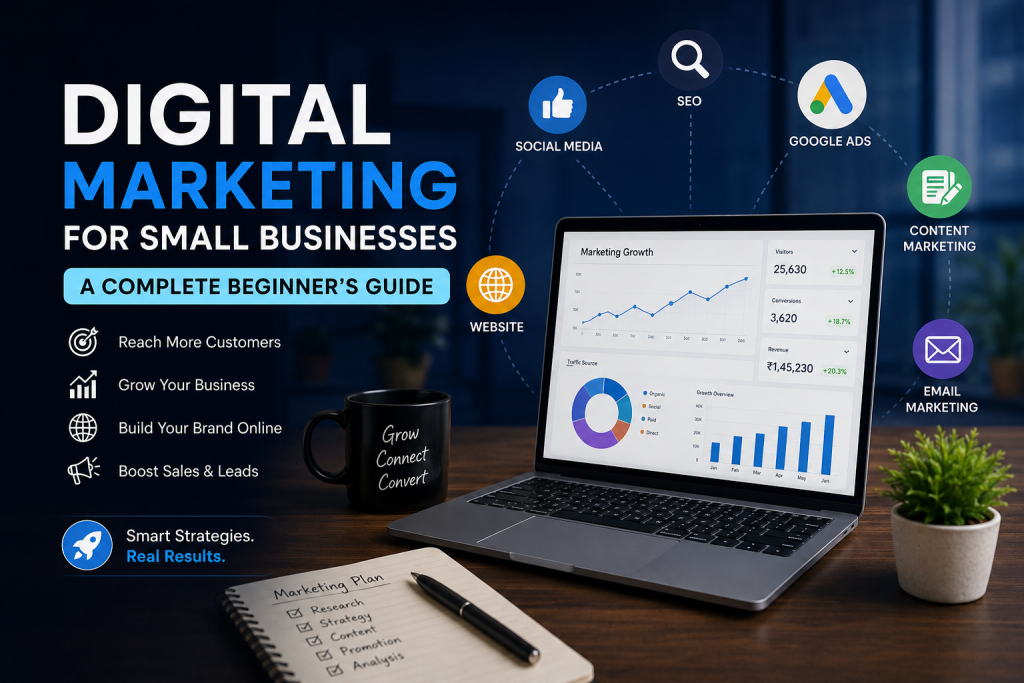
Digital marketing for small businesses is one of the most affordable and effective ways to attract customers, generate qualified leads, and increase sales. With the right combination of SEO, social media marketing, Google Ads, email marketing, and local SEO, small businesses can compete with larger brands without needing a massive marketing budget.
This guide walks through 10 practical strategies, what they cost, the mistakes that quietly waste money, and a simple order to follow if you’re starting from zero.
What Is Digital Marketing for Small Businesses?
Digital marketing for small businesses means using online channels — search engines, social media, email, and paid ads — to find customers, build trust, and generate sales, instead of relying only on offline methods like print ads or referrals.
It isn’t one activity. It’s a handful of channels working together: a website that shows up on Google, an Instagram page that keeps you visible, an email list that brings people back, and maybe a small ad budget that fills the gaps. Small businesses that do this well usually aren’t doing everything — they’re doing two or three things consistently.
Why Digital Marketing Is Important for Small Businesses
A few years ago, a shop in a good location with decent word-of-mouth could survive on that alone. That’s harder now. Most people check Google or Instagram before they walk into a store, book a service, or call a vendor.
Here’s what digital marketing for small businesses actually delivers, in practical terms:
- Visibility beyond your neighborhood — a bakery in Nashik can reach customers across the city, not just people walking past the shop.
- Lower cost per customer compared to print ads, hoardings, or newspaper inserts.
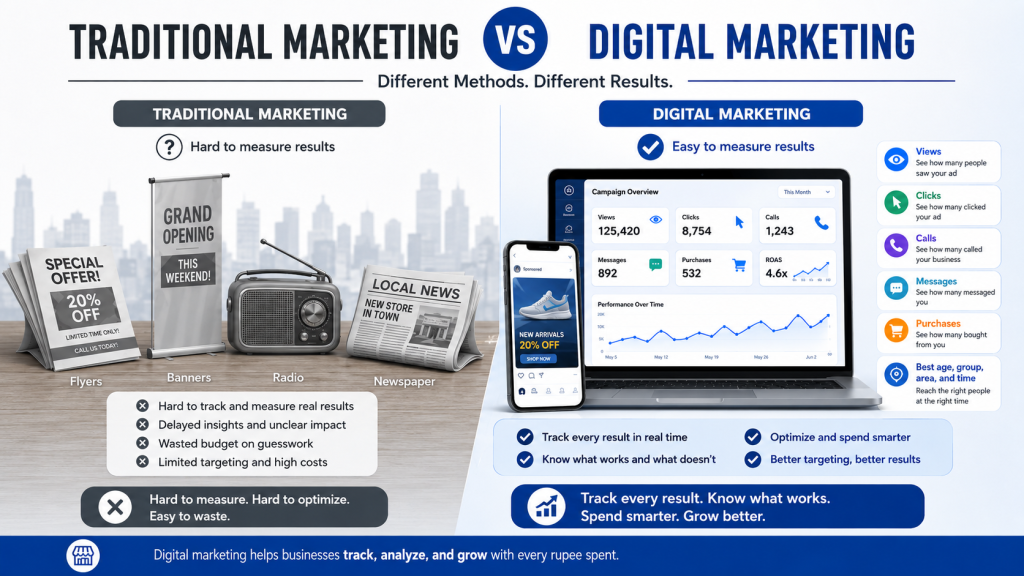
- Measurable results — you can see exactly how many people saw your ad, clicked it, and bought something.
- A level playing field — a well-run local business can outperform a bigger competitor online if the marketing is smarter, not just bigger-budget.
A local tailor started posting before-and-after stitching photos on Instagram. Within a few months, half his new customers were people who’d never have found his shop otherwise. That’s the realistic upside — not “going viral,” just being findable when someone’s looking.
Digital Marketing vs Traditional Marketing
Traditional marketing — flyers, banners, radio spots — still has a place, especially for very local, older audiences. But it has one big limitation: you rarely know if it worked.
| Factor | Digital Marketing | Traditional Marketing |
|---|---|---|
| Cost | Flexible — start with ₹300–₹500/day | Usually higher upfront (printing, airtime) |
| Targeting | Precise — by location, age, interest | Broad, not audience-specific |
| Tracking | Clicks, calls, conversions all visible | Almost impossible to measure directly |
| Speed | Live within minutes (ads) or weeks (SEO) | Days to weeks for print/production |
| Reach | Local, national, or global — your choice | Mostly local and limited |
| Flexibility | Change copy, budget, or audience anytime | Once printed or aired, it’s fixed |
| Suitable for | Most small businesses, especially service and retail | Very local, older, offline-first audiences |
The takeaway isn’t that traditional marketing is dead — it’s that online marketing for small businesses gives you a feedback loop traditional channels never could. That data lets you spend your next rupee more wisely than the last one.
10 Digital Marketing Strategies for Small Businesses
There isn’t a single “digital marketing” button to press — it’s several strategies working together. These are the 10 that matter most when you’re planning digital marketing for small businesses from scratch.

1. Build a Fast and Mobile-Friendly Website
Your website is where every other channel eventually sends people. If it’s slow or hard to use on a phone, you lose them before they even see what you offer.
Why it matters: Most local searches happen on mobile. A site that takes more than a few seconds to load, or doesn’t resize properly on a phone screen, pushes visitors straight to a competitor.
Example: A furniture workshop rebuilt its old, image-heavy site into a lightweight three-page version — home, catalogue, contact. Load time dropped from 8 seconds to under 2, and form submissions nearly doubled the following month.
Actionable tip: Compress every image before uploading, and test your site speed with Google’s PageSpeed Insights at least once a quarter.
KPI to track: website traffic, bounce rate, and form submissions.
2. Use Local SEO and Google Business Profile
Local SEO for small businesses is about showing up when someone nearby searches for what you sell — “electrician near me” or “best bakery in Nashik.”
Why it matters: A complete, active Google Business Profile is often the single highest-return thing a local business can do, and it’s free.
Example: A salon that added fresh photos weekly and replied to every review saw its profile start appearing in the local map pack for searches it never ranked for before.
Actionable tip: Fill in every section of your profile — hours, services, photos — and respond to reviews within 48 hours, good or bad.
KPI to track: local search visibility, phone calls, and direction requests from the profile.
3. Improve SEO for Small Businesses
Beyond your Google profile, SEO for small businesses means getting your actual website pages to rank for what customers search — “handmade jewelry near me” or “AC repair Nashik.”
Why it matters: SEO traffic is free once it starts flowing, and it tends to convert well because people are actively searching, not just scrolling.
Example: A tuition center added a page answering “how to choose a tuition class for class 10,” written in plain language with the city name mentioned naturally. It now brings in a handful of enquiries every week without any ad spend.
Actionable tip: Write one page per service or product, using words your customers actually type — not internal jargon.
KPI to track: organic website traffic and keyword rankings.
4. Create Helpful Content
Content marketing for small businesses means publishing useful information — blog posts, short videos, simple guides — that answers questions your customers already have.
Why it matters: It isn’t about selling directly. It’s about being useful enough that people trust you before they ever spend money with you.
Example: A gym published a post on staying active during monsoon instead of just running membership ads. It kept ranking on Google for over a year and quietly brought in new sign-ups every month.
Actionable tip: Write down the five questions customers ask most often in person, then turn each into a short blog post or reel.
KPI to track: blog traffic, time on page, and leads generated from content.
5. Use Social Media Marketing
Social media marketing for small businesses is how you stay visible between purchases. A customer might not need your service today, but if they see your work regularly, you’re the first name that comes to mind when they do.
Why it matters: It works best when it’s specific to your business, not generic — a furniture maker showing the actual process of building a table does better than one posting stock quotes about hard work.
Example: A home baker posting three ordinary process videos a week outperformed a competitor posting one heavily edited reel a month.
Actionable tip: Aim for consistency over polish — three simple posts a week beats one perfect post occasionally.
KPI to track: engagement rate, follower growth, and messages/DMs received.
6. Start Email Marketing
Email marketing for small businesses is one of the most underused tools, and one of the cheapest. If someone buys from you once, a simple monthly email keeps you on their radar without paying for ads every time.
Why it matters: You already have the customer’s attention — email just keeps it, instead of letting it fade.
Example: An automotive workshop sends a reminder email when a customer’s car is due for servicing. That single email routinely brings back business that would otherwise be lost.
Actionable tip: Start collecting emails at checkout or booking, even in a simple spreadsheet, and send one useful email a month.
KPI to track: open rate, click-through rate, and repeat purchases.
7. Run Google Ads for Small Businesses
Google Ads for small businesses put you at the top of search results instantly, for keywords you choose. Unlike SEO, you don’t wait months — you pay per click and show up right away.
Why it matters: It works well for clear, high-intent searches like “AC repair near me” or “wedding photographer in Nashik,” where the person is ready to act.
Example: A photography studio started with ₹400/day on tightly targeted keywords and tracked which searches led to actual bookings, not just clicks.
Actionable tip: Start small, and use Google Ads Help to set up conversion tracking before you scale the budget.
KPI to track: click-through rate, cost per lead, and return on ad spend.
8. Use Facebook and Instagram Ads
Meta Ads work differently from Google Ads. Instead of catching people actively searching, they show your business to people based on interests, age, location, and behavior.
Why it matters: This is useful for introducing your brand to people who didn’t know they needed you yet — awareness before intent.
Example: A home décor brand used Meta Ads to reach people interested in interior design within a 10 km radius, building recall before anyone searched for the brand by name.
Actionable tip: Use a small awareness budget first, then retarget people who engaged with a follow-up offer.
KPI to track: cost per acquisition, reach, and website visits from ads.
9. Collect Customer Reviews
Reviews are one of the most direct trust signals for both customers and Google’s local ranking algorithm.
Why it matters: People check reviews before calling a plumber, booking a salon, or ordering from a new restaurant — a business with zero or old reviews looks abandoned, even if it isn’t.
Example: A clinic started asking satisfied patients for a quick Google review right after their visit. Review count tripled in three months, and so did profile views.
Actionable tip: Ask at the moment of highest satisfaction — right after a good service, not days later over email.
KPI to track: review count, average rating, and local search visibility.
10. Track and Improve Marketing Performance
None of the above matters much if you’re not checking what’s working. Small businesses that improve fastest are the ones reviewing their numbers monthly, not guessing.
Why it matters: Without tracking, you can’t tell if a ₹10,000 ad spend brought in ₹2 lakh in sales or almost nothing.
Example: A retail store started checking Google Analytics monthly and noticed most online enquiries came from Instagram, not Google — so it shifted budget accordingly.
Actionable tip: Set a recurring 30-minute monthly check-in to review traffic, leads, and conversion rate — even a simple spreadsheet works.
KPI to track: conversion rate, cost per lead, and cost per acquisition.
How Much Does Digital Marketing Cost for a Small Business?
There’s no single right number — it depends on your industry, competition, location, and goals. But here’s a realistic starting range for planning purposes:
| Business Type | Suggested Monthly Budget | What It Typically Covers |
|---|---|---|
| Micro business (solo or 1–2 staff) | ₹5,000 – ₹10,000 | Google Business Profile management, basic social posting, small ad tests |
| Small local business | ₹10,000 – ₹25,000 | Local SEO, regular content, Google Ads or Meta Ads, review management |
| Growing business | ₹25,000 – ₹60,000+ | Full SEO, multi-platform ads, email marketing, ongoing content and reporting |
These are starting ranges, not guarantees — actual costs depend heavily on your competition, city, and how aggressive your growth goal is.
Common Digital Marketing Mistakes Small Businesses Make
Most failed efforts aren’t due to bad platforms — they’re due to avoidable habits:
- Running ads without a clear goal — boosting a post because “it felt like the right thing to do,” instead of aiming for calls, bookings, or sales.
- Ignoring the Google Business Profile — setting it up once and never updating photos, hours, or responding to reviews.
- Posting inconsistently — going quiet for weeks, then posting five times in one day.
- No way to track results — running ads without checking which ones actually brought in customers.
- Copying competitors blindly — using the same offers and content as a rival instead of figuring out what makes the business different.
- Expecting instant results from SEO — treating a 3-month strategy like it should work in a week, then giving up.
Most of these come down to a lack of a plan rather than a lack of effort.
Step-by-Step Digital Marketing Plan for Beginners
If you’re starting from scratch, here’s a realistic order to follow:
- Set up your Google Business Profile — real photos, correct address, hours, and services.
- Build or update your website — even a simple one-page site with services, contact number, and location works.
- Pick one or two social platforms — don’t try to be everywhere; Instagram and Facebook cover most small businesses well.
- Post consistently for a month — before spending on ads, see what content your audience already responds to.
- Start a small Google Ads or Meta Ads budget — ₹300–₹500 a day is enough to test what works.
- Collect customer emails or phone numbers — even a simple spreadsheet is a start for future email marketing.
- Track everything — calls, messages, and sales from each channel, weekly.
- Double down on what works, drop what doesn’t — after a month, you’ll have real data instead of guesses.
This order matters. Businesses that jump straight to paid ads without a decent Google profile or website often waste money sending clicks to a page that doesn’t convert.
Should You Hire a Digital Marketing Agency?
Doing all of the above yourself is possible, but it takes time most business owners don’t have. This is usually where a digital marketing agency for small businesses earns its cost — not by doing anything mysterious, but by handling the ongoing work of ads, content, and tracking consistently, week after week.
If you’re in Nashik, working with a local performance marketing agency also means someone who understands the local market, competition, and customer behavior in your city — not a generic strategy copied from a metro-city playbook. If you’d like a second opinion on your current approach, DataByte’s digital marketing services cover exactly this — strategy, execution, and reporting, in one place.
Frequently Asked Questions
What is digital marketing for small businesses?
It’s the use of online channels — SEO, social media, email, and paid ads — to attract customers, build trust, and generate sales. For a small business, it usually means focusing on two or three channels done well, rather than trying to be active everywhere at once.
How much should a small business spend on digital marketing?
There’s no fixed number, but many small businesses start with ₹5,000–₹15,000 a month, covering ads and basic content, then scale up based on results. Actual budgets depend on your industry, competition, and goals — see the budget table above for a rough starting point.
Which digital marketing strategy is best for a small business?
There’s no single best strategy — it depends on your business type. Service businesses often see the fastest results from local SEO and Google Ads, while product-based or lifestyle brands tend to benefit more from social media and content marketing.
How long does SEO take to produce results?
Usually 3–6 months for noticeable improvement in organic rankings, though local SEO (Google Business Profile visibility) can show faster results within weeks. SEO for small businesses is a long-term channel, not a quick fix.
Is social media marketing necessary for small businesses?
Yes, in most cases. Ads and SEO bring in new customers, but social media marketing for small businesses keeps existing customers engaged between purchases. The two work best together rather than as substitutes for each other.
Should a small business use Google Ads or Meta Ads?
It depends on intent. Google Ads for small businesses works well when people are already searching for your service; Meta Ads work better for building awareness among people who aren’t searching yet. Many businesses eventually use both for different goals.
Can a business handle digital marketing without an agency?
Yes, especially in the early stages. Many businesses start solo and bring in an agency once they need consistency, better ad targeting, or more time to focus on running the business itself.
How can a local business attract more customers online?
Start with a complete Google Business Profile, ask happy customers for reviews, and post consistently on one or two social platforms. These three steps alone cover most of what local SEO for small businesses depends on, before any ad spend is involved.
Final Thoughts
Digital marketing for small businesses isn’t about mastering every platform at once. It’s about picking a few strategies that match your business, doing them consistently, and improving based on real numbers instead of guesswork.
If you want to go deeper on scaling beyond these basics, our related guide on digital marketing for business growth covers the next stage, and common digital marketing problems and solutions is worth a read if something you’ve already tried isn’t working.
Grow Your Small Business with DataByte
Want to grow your small business online? DataByte digital marketing agency helps small businesses with SEO, Google Ads, Meta Ads, social media marketing, website development, content marketing, performance tracking, and AI-powered marketing solutions — all built around your budget and goals, not a one-size-fits-all package.
If you’d rather have someone handle the strategy while you focus on running your business, request a digital marketing consultation or call +91 9850508200. You can also browse our digital marketing FAQs if you have a specific question before reaching out. Any details you share are handled as described in our privacy policy.